Showing posts with label Movies. Show all posts

Monday, March 9, 2026

Now for something topical! A fifteen-year-old review of Rango

 I originally wrote this review for Geek Speak in 2011. I tried to be good about not double posting if I was writing somewhere else. I didn't want to steal their traffic. (I'd typically just post a link.)  However, Geek Speak has long since folded, so I figured I might as well post this here. If you were wondering what I thought of Rango fifteen years ago, wonder no more! 

Rango


Fifteen minutes could save you 15% on your car insurance

I was pleased to be the one to review Rango because it got me a night at the movies with my kid  (My wife was pleased as well because it got her a night to herself. Everybody wins on movie night!)

We went to our local theater and got there in time for the coming attractions. Coming soon to a theater near you:

  • Born to be Wild: Cute baby Animals! In 3-D!
  • Puss in Boots- The length of the Shrek series is out of proportion with my interest in it. In 3-D!
  • Kung Fu Panda 2: The Dreamsworks Face! In 3-D!
  • Smurfs: My childhood dies! In 3-D!

And then there was Rango. We open on an owl mariachi band, which is, by definition, awesome. I firmly believe that there does not exist a movie that cannot be improved by the presence of an owl mariachi band.

We then cut to our nameless chameleon, hamming it up in a one-man play with some toys while in a car with a human family. But there is a near accident and the chameleon and his terrarium are thrown from the family car. He briefly winds up on the windshield of a car driven by someone who looks an awful lot like Hunter S. Thompson, which was an awesome cameo, because Depp played Thompson in the film adaptation of Fear and Loathing in Las Vegas.

I really like the design on Rango. I had never owned a chameleons and I had to ask myself do they really look that freaky? The internet says yes!

Look at those bug eyes, man!


He meets an Armadillo with the voice of an octopus (Specifically "Doctor" Octopus, Alfred Molina) a combination certain to give taxonomists fits for years to come and is told to seek the Spirit of the West.

He has a surreal series of dreams overnight involving his experiences and then runs into Beans. I didn't know what kind of animal she was supposed to be while watching the movie but the promotional materials assure me that she's a desert iguana.  Whatever she is, she needs to cut back on the sodium.


Our still nameless Chameleon enters the town of Dirt, where he decides that nobody knows him here, he can reinvent himself, and he does, taking on the identity of the hard-drinking, tough-talking, straight-shooting Rango with chameleon-like ease.

Through a series of misadventures, Rango winds up defending Dirt against the hawk that haunts the town. I thought this was a really well done sequence, with the filmmakers doing an excellent job of depicting the difference in scale between the tiny Rango and the much larger bird. There is also an amusing bit where Rango hides inside a vending machine, which makes an ideal fortress...until the hawk finds a quarter and drops it in a slot. Rango can't bring himself to shoot the hawk, so he aims at random, and kills the hawk when his ricocheting bullet drops a water tower on top of it. For his, uh, heroism, he's promoted to Sheriff by the evil Mayor (Ned Beatty).

And boy, you'd think that someone as infatuated with the concept of theater as Rango would recognize a villain when he sees one. It's a shame that tortoises can't grow a mustache, because twirling it would have given him something to do with his hands. And I guess that's kind of an itty bitty spoiler, which I try to avoid in my reviews, but the mayor was obviously the villain from the start. The big surprise would have been if the mayor were anything but the villain.

We follow Rango the sheriff around for a while, and he has a charming goofy enthusiasm for the job matched only by his utter incompetence at it. Eventually the water bank is robbed, leaving the impoverished town even more parched. Rango organizes a posse and they find the robbers. There follows an ambush, a reversal, a lengthy chase scene and a couple chords of the Ride of the Valkyries on a banjo, which is just neat! The action sequence was characteristic of those in the movie, very quick moving but also very easy to follow. I wish more live action movies would film action sequences this tight.

They arrest the bank robbers and take them in, though they protest that the water was already gone by the time they found the bottle. Nobody's sure what's going on (hint: the mayor is what's going on), but they take the water thieves back to town.

Rango confronts Mayor McEvil about his evil, but doesn't have any proof. The mayor decides to call in Rattlesnake Jake to rid him of this meddlesome sheriff.

Jake slithers into town and he's downright terrifying, just endless miles of coiled menace, blood-red eyes, and some kind of gatling gun for a rattle. He's voiced by Bill Nighy, cementing the impression of evil incarnate. He scared my four-year-old child He scared me!

He sees Rango for the fraud he is and intimidates him into admitting the whole masquerade and then runs him out of town.  Rango finally gets to the other side of the road, where he meets Roland Deschain, Clint Eastwood, the Spirit of the West in a scene that was quite a bit too cutesy and self-referential for my tastes. (Specifically, the idea of the Man with No Name riding around in a golf cart full of Oscars)

No-Name tells Rango that he can't just walk out of his own story, and this inspires Rango to make things right. TV Tropes calls it "becoming the mask". You probably know the concept, if perhaps not the name, where the character who was trying to pull off a con finds redemption by embracing the ideals of the identity he was faking.

The problem is resolved about like you'd expect. Rango rides back into town, there is a confrontation, Mayor McEvil is evil and he dies in such a way that doesn't require Rango to compromise his values.

The movie got made because Gore Verbinski wanted to do a "small film" between films #212 and #213 in the Pirates of the Caribbean series and Johnny Depp had 20 days to kill. Overall? It's not bad. Johnny Depp can usually be relied upon to give a quality performance, and whatever problems the film has, it's not with his performance. It's a somewhat above average CG adventure story.  It never reaches the heights of Up! or becomes as incredible as the Incredibles, but it's a cute little flick for kids and for adults who don't mind hearing paraphrased Rango quotes for the next six weeks from their kids.

Tuesday, June 19, 2018

Coming Soon: Josh and Lily debate The Incredibles 2


Who is right about the movie?

Josh?


Or Lily? 


Stay tuned to find out!

Tuesday, April 3, 2018

A Wrinkle in Time

I've lost faith in a lot of the things I believed in as a child.

I stopped believing in God and Santa Claus decades ago and on bad days I don't even believe in myself.

But I still believe in a Wrinkle in Time.


It is my desert island book. It's the book that reminds me that there is still goodness in the world.

The 2003 movie was pretty bad, but I approached this version with tempered enthusiasm. Jennifer Lee had been the screenwriter for Frozen, so that was encouraging.

But I really don't understand how she managed to miss the meaning of the book so completely. It's one of the few properties about which I'm still sentimental and they messed it up so badly that I was just short of actually angry.

I guess I'll open with what I liked about the movie.

THE GOOD

Meg Murray: Meg is probably white in the book, but that whiteness isn't essential to her character, so I don't have any problems with the change. Storm Reid (who has a great name) does an outstanding job with the performance. I'd go so far as to say that she's the best part of the film. The idealized Meg with straightened hair was a good scene, and I don’t think it would have had the same punch with a white girl in the role.

The scenes with baby Meg and her dad were really cute too.

Red: He was a departure from the character in the book, but I thought Red worked pretty well. The bit with the sandwich being literal sand (instead of just tasting like sand) was a bit on-the-nose for my liking, but affably evil characters can be frightening in a way more obviously evil villains aren’t and he’s a good contrast to the capital E Evil of the IT. The puppet metaphor went on a bit too long, but it wasn’t bad conceptually.

The IT: This is another change that more or less worked. Calling the adversary “IT” works in a novel, where you can see the capitalization, but it would lead to confusion in a movie already populated by Whos, Whiches and Whatsits galore.  Adding the article in front of IT is a small change, but I would argue that it’s almost a necessary one for clarity’s sake. Also, the weirdo psychedelic brainscape was a little ostentatious (like the rest of the movie), but a.) at least there was no glitter and b.) IT as described in the book (a slightly oversized brain on a dais) probably would have looked silly on screen.

Enfolded: I liked the recurring motif of things being present but hidden from sight because they’re enfolded. The visual of the paper fortune teller works and the set-up more or less pays off. I thought they were going to use it to illustrate a tesseract, but they didn’t, and that seems like a missed opportunity.

Some good scenes: The montage of misery on the earth was a truly well-composed sequence.  Ava DuVernay does a great job with the quiet, human moments, and those moments should have served as the core of the movie, but they were lost in favor of spectacle.

The Bad

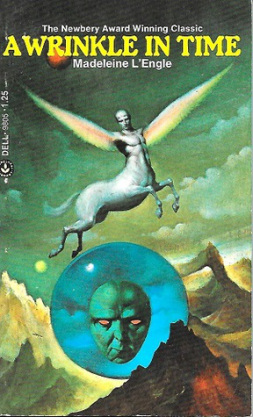
Mrs. Whatsit: "Now, don't be frightened, loves," Mrs. Whatsit said. Her plump little body began to shimmer, to quiver, to shift. The wild colors of her clothes became muted, whitened. The pudding-bag shape stretched, lengthened, merged. And suddenly before the children was a creature more beautiful than any Meg had even imagined, and the beauty lay in far more than the outward description. Outwardly Mrs. Whatsit was surely no longer a Mrs. Whatsit. She was a marble-white body with powerful flanks, something like a horse but at the same time completely unlike a horse, for from the magnificently modeled back sprang a nobly formed torso, arms, and a head resembling a man's, but a man with a perfection of dignity and virtue, an exaltation of joy such as Meg had never before seen. No, she thought, it's not like a Greek centaur. Not in the least.

From the shoulders slowly a pair of wings unfolded, wings made of rainbows, of light upon water, of poetry.

Hold that image in your mind. The book cover at the top of the post can serve as a useful reference. Go back and read it again if you need to. I didn't see anything describing a flying piece of asparagus with Reese Witherspoon's chin, but that's what we got.


It's nice to see Archibald is still finding work after Veggie Tales.

I want everyone to know that Lily is the one who came up with asparagus joke.

Mrs. Who:
 Her distinguishing trait in the novel is that she speaks in quotations. They dispense with that about a third of the way through the movie, at about the point where she wore a bustle while running through flowers who were also running.


She loses additional points for quoting Chris Tucker. What’s the matter, couldn’t they get the rights to wubba lubba dub dub? Mrs. Who quotes Chris Tucker and the attribution, “Tucker, American” is longer than the quote. Ugh. Listen. I understand the desire to be topical, and those kids today (shakes rake at them to warn them off my lawn) aren’t going to understand the provenance of a quote by Blaise Pascal. But this is barely even a catchphrase.

Mrs. Which: I was nervous about Oprah Winfrey in the role because I thought her presence would prove distracting because she's one of the most famous human beings in the world.


I was wrong. She was even more distracting than I had feared because she was one hundred feet tall and covered with glitter.

The Titans have breached Wall Maria. 

In the movie, she says, "Trust nothing." Do you have that  Fox Mulder "I want to believe" poster hanging on your wall, Mrs. Which?

Give me that old-time religion: I'm not religious myself, but Madeleine L'Engle's particular brand of Christian Universalism serves as the core of the book.("All will be redeemed in God's fullness of time, all, not just the small portion of the population who have been given the grace to know and accept Christ. All the strayed and stolen sheep. All the little lost ones.")

I don't think it can be removed without changing the story fundamentally and you certainly can't just rip it and continue on with nothing in its place, as was done here. The movie is empty inside.

The Writing: It's often just bad. "She's evolved beyond the need for language." "Charles Wallace doesn't live here anymore." Seriously? Even children's cartoons know they can't get away with playing that line straight anymore. Calvin disappears almost completely for the final twenty minutes of the movie. We were joking that he'd be calling for the other characters on Camazotz during a post-credit sequence.

Crappy Mentors: A Wrinkle in Time served as an influence on my Doctor Who story, Forever Fallen. I also loved the Doctor's relationship with Ace because he could solve her problems for her easily enough, but instead, he helps her become the version of herself capable of solving those problems. That same dynamic is at play in the book, but the movie features mentors that neither like nor respect their charges and it just doesn't work. What's the point?

The Happy Medium:  Zach Galifianakis plays the medium as a gymnast/soothsayer. Kudos for playing against type, but not an interpretation that grounds the movie, is it?

Walk like an Egyptian
Charles Wallace goes down like a chump: In the book, Charles Wallace goes into IT’s grasp willingly, because IT has promised him that the location of his father is in there and he believes he’s strong enough to pull himself out once he’s in there. Pride is his fatal flaw and it’s this overconfidence that gets him.  In the movie, The Man with Red Eyes takes control of Charles Wallace by reading from his second-grade math homework.


I’ve touched on this before, but love is the theme of the book. Meg is poisoned by doubt, but she knows as certainly as she knows anything that Charles Wallace loves her. Her mother loves her. Her father loves her. They love each other and despite her doubts about other things, Meg knows this. The Mrs. Whatsit of the books loves her.
"Mrs. Whatsit hates you," Charles Wallace said.
And that was where IT made ITs fatal mistake, for as Meg said, automatically, "Mrs. Whatsit loves me; that's what she told me, that she loves me," suddenly she knew.
She knew!
Love.
That was what she had that IT did not have.
She had Mrs. Whatsit's love, and her father's, and her mother's, and the real Charles Wallace's love, and the twins', and Aunt Beast's.
And she had her love for them.
But how could she use it? What was she meant to do?
If she could give love to IT perhaps it would shrivel up and die, for she was sure that IT could not withstand love. But she, in all her weakness and foolishness and baseness and nothingness, was incapable of loving IT. Perhaps it was not too much to ask of her, but she could not do it.
But she could love Charles Wallace. She could stand there and she could love Charles Wallace. Her own Charles Wallace, the real Charles Wallace, the child for whom she had come back to Camazotz, to IT, the baby who was so much more than she was, and who was yet so utterly vulnerable.
Charles. Charles, I love you. My baby brother who always takes care of me. Come back to me, Charles Wallace, come away from IT, come back, come home. I love you, Charles. Oh, Charles Wallace, I love you.
Movie Mrs. Whatsit’s opinions on Meg range from disgust to disinterest. Why is she even there if she feels this way?

What I’d like to see is a more or less straight adaptation of the book as an animated film by studio Ghibli. Hayou Miyazaki can helm it the next time he comes out of retirement.

Grrr...So bitterly disappointed in what we got.


Monday, February 19, 2018

Black Panther (Spoilers)


We open right away with some “Daddy, tell me our origin story” exposition, which is fine. We’re well into our second decade of superhero movies as their own genre and we know the template by now. I’m fine with a Doomed Planet/Desperate Scientist/Last Hope/Kindly Couple expository infodump at the beginning of any such movie from now until the end of time.

I liked the prologue in 1992 Los Angeles quite a bit. Superhero movies tend to be loud and on-the-nose at their worst, but when the warriors arrive and N'Jobu says to open the door for the “Grace Jones” women because “they won’t knock again”, it was a nice understated declaration of who these women are.

T’Chaka was in a situation with no good options. He probably didn’t make the best choice, but whether you complete the sentence that starts with, “Hey kid, we killed your father and” with

“we’re leaving you here”
or
“we’re taking you away from everything you’ve ever known and you’re going to be raised by your father’s murderer.”

He’s certainly going to grow up resenting you. It’s like a no-win choice from a Telltale game.

 Nakia: Lupita Nyong'o’s Nakia didn’t have a whole lot to do and she wasn’t strictly necessary to the plot, but I did like how she responded in her introduction. When T’Challa is retrieving her from the Boko Haram convoy and he tells her that he wants her back for the coronation, an entire world of emotions flows across her face. Then she replies that she will come back.  There is a maturity there. This is her duty and she will discharge it faithfully with none of the oppositional defiant disorder that plagues super-hero movies.

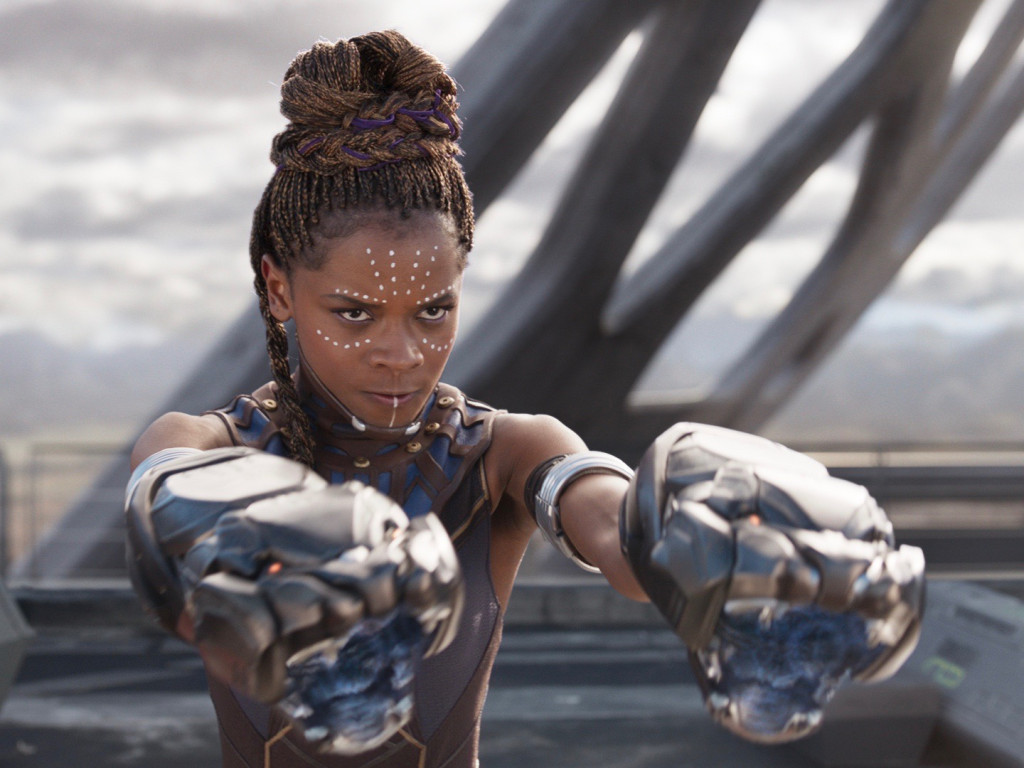
Shuri: Letitia Wright was the best part of the movie as T’Challa’s sister Shuri. We totally need a sequel with the same cast but focus on her. I had guessed that she was in her early twenties, but the character is supposed to be sixteen, which is a pretty large gap between the two siblings.  She was a fun character to watch and the fact that she’s an almost unique role-model for African-American girls is almost incidental.

M’Baka was an interesting character. I liked him in the beginning as a bit of a devil’s advocate. I believe that authority should be questioned and M’Baka serves this role when he challenges T’Challa. My read was that he didn’t necessarily want to be king himself, but he wanted to make sure that T’Challa was the best-qualified person for the job. He didn’t want to rubber stamp the coronation.

(Also, during that fight I really loved it when T’Challa’s mom shouted, “Show him who you are!” to inspire her son. I appreciate the kind of quiet confidence.)

I also appreciated his question when T’Challa’s mom asks him to avenge her son’s murder later on in the movie and when he’s assured that the odds were fair, replies with something like, “Sounds like it was more a defeat than a murder.”

(Apparently, the character also goes by “Man-Ape” in the comics. They didn’t use that for the movie because it’s obviously tremendously super-racist.)

If you’ll excuse the digression for a moment, when I was watching Broadchurch with Jen she thought that the Scottish detective really looked like David Tennant, but assumed that he wasn’t, because I surely would have said something if he was. But all through the first episode, until she saw his name in the end credits, she assumed he was another actor who bore a startling resemblance and she was continuously distracted by that.  (In my defense, what was I going to say? “Hey, it’s David Tennant!”?)

I finally got to experience what it’s like being on the other side of the question. Every time W'Kabi was on screen I was asking myself, “Is  that Chris from Get Out or just somebody who looks like him?” (Spoilers: It is Daniel Kaluuya who played Chris, so point for Josh)

I think he was one of the few weak points in the narrative. Ulysses Klaw killed his parents and he makes T’Challa promise to kill him or bring him in for trial. Klaw is captured, but escapes and W'Kabi is so angry with T’Challa that he is instrumental in the coup that overthrows him. But cut the dude some slack. I’m not completely sure of the time frame, but he’s been king for less than a week, possibly for as little as a day. T’Challa has shown the intent to capture Klaw; he just hasn’t managed to do it yet in the extremely brief span of time that has elapsed.

Speaking of Klaw. Or Klaue, if you must. He was entertaining for the brief time he got. Manic, but not  “This is one doodle that can't be un-did, Homeskillet” level of obnoxious quirkiness. I was expecting to be annoyed by Martin Freeman, but I did like their exchange in the casino when Klaue offers a link to his mixtape and Martin’s Agent Ross deadpans, “Please don’t make me listen to your music.”

Roth must be the worst intelligence operative in the world, because he admits that he worked to cover up T’Challa’s involvement in Civil War, but never seemed to wonder where the Black Panther Iron Man level super-suit came from.  I can understand his willingness to help cover it up as part of some quid pro quo, but he never even seemed to ask the questions that would lead him to wonder why the leader of an apparently impoverished country had such a tool.

Michael B. Jordan is always great in everything he does. He continues the Chris Evans route of
going from Johnny Storm to someone else in the Marvel Universe.  His plot seemed to hinge on a number of unlikely events all coming to pass exactly as planned(meeting W'Kabi perhaps the only person who is sympathetic and in a position to help, being given a forum to plead his case and issue his challenge, T’Challa accepting the challenge and losing it) , which isn’t unusual for a super-hero movie, but I feel that Black Panther could have done better in this regard, since it was a cut above in almost every respect.

Perhaps I missed something, but are people allowed to challenge the king whenever they feel like it? I figured it was a “speak now or forever hold your peace” type deal and he wasn’t there. Sorry, you missed open enrollment in the regicide Olympics. Try again next year

Maybe he got special dispensation because he was of royal blood? It seems like it’s a pretty dumb system of government if anyone can challenge the king at any time.

Those are trivial complaints, though. He was a great villain with an understandable goal. Jordan oozes charisma and he owns this role. A common criticism of Marvel’s movie villains is that they come across as flat in their motivations, but both Killmonger and his father had goals and values that would be laudable under other circumstances.

I loved the world building that went into the movie. I don’t have the background to appreciate it beyond an extremely superficial level, but I love the thought that went into the choices for the clothing and languages and customs of the tribes.

I’ll end with a comment on representation. I’m a straight middle-class cis-gendered white American male. To a first order approximation, everyone I grew up watching on TV looked like me.  I’m sure the movie-makers faced pressure to make the movie less Afro-centric and I’m glad they stuck to their vision, because it is those elements that make this movie as enduring as I know it will be.

Friday, January 12, 2018

Star Wars: The Last Jedi


I can’t think of a specific set piece that I hated more than Poe’s phone call at the beginning. It embodies everything I dislike about the Star Wars universe. Poe was the breakout star of The Force Awakens. He had been slated to die, but they changed the script to allow him to live because everyone loved him so much, and this scene made me hate Poe.  Also, the writing was just terrible, with Hux channeling Rolf the Nazi boyfriend from the Sound of Music and speaking in “Your father, the king” exposition

Blue Milk: I had actually absorbed Alton Brown’s explanation from several years back that the blue milk from Star Wars was not actually milk.

All milks are colloids, essentially water in which protein spheres and fat globules are held in suspension. The protein and fat scatter visible light in such a way as to appear white. Now, skim milk can look bluish, because without much fat more light bounces off small clusters of protein mol­ecules called casein micelles, which tend to scatter shorter (blue) wavelengths. But even if it were completely fat-free, milk could never look that blue.

And why would farmers have fat-free milk anyway? It makes no sense. You could argue that the milk on Tatooine contains some completely alien protein, but even then you’d have to explain where the heck this blue milk came from. Clearly, this is a desert planet with no signs of herding animals ­capable of being milked by ­humble farmers. Bantha? Ha!

But it could be plausible! Alton speculates that the blue milk could be a vegetable milk, like Tatooine soy — and that Luke Skywalker’s adopted parents were vegans. “This would explain their dour, grumpy demeanor,” he notes, “and as we see later from their remains, they’re already suffering considerable loss of bone mass. I rest my case.”

Kind of gross and unnecessary, but whatever.

A slap across the face is always bad writing unless one character is challenging another to pistols at dawn

It’s weird that the best parts of the movie involve Kylo Ren.


I thought Leia’s floating through space bit was cheesy, but I don’t think I could have handled it if they had killed her off.

Laura Dern’s character should have treated Poe with more courtesy, but she was never wrong. I’ve never been in the army, but I’m pretty sure it doesn’t work well if everybody runs off to do whatever they feel like.

“We are the spark that will light the fire that will burn the First Order down.” That’s a little awkward and unwieldy,  but I’m willing to forgive it if it turns out to be a reference to "The Force That Through the Green Fuse Drives the Flower".

Rose was wonderful. The story needed a human character instead of the high mimetic mode archetypes and she was perfect.


There was no tension in the chase scene and I think that was the biggest problem with the movie.  It should have been oppressive and relentless and inevitable. Instead, it was a leisurely jaunt through outer space that permitted a forty-five-minute excursion to Space Monte Carlo.


I yelled out, “It’s the Boy Who Lived!” when Luke failed to kill Kylo Ren.

I thought Yoda was used really well. Best use of the character since Empire.

Poe’s mutiny pissed me off. He’s clearly fucking up constantly throughout the entire movie, but the audience is meant to sympathize with him. Also, it made Leia look dumb for putting the Vice Admiral in a position where she would be promoted to the leadership role.

At this point I felt that the movie was a deeply shitty film with some standout moments, and almost in the span of a scene I went to thinking of it as a flawed masterpiece.

The codebreaker betrays them, Snoke set them up. Most importantly, Laura Dern had a plan and Poe fucked it up with his antics.

I really enjoyed the scene in the throne room. Snoke is kind of a tool, and he looks goofy, but at least he dies after setting up a pretty cool scene.

The salt planet had some striking visuals. Jen liked the salt foxes.

I liked everything about Luke’s appearance there. How Kylo Ren first tries to kill him with the AT-ATs before coming down to for the duel. It didn’t work, but props for trying. It reminded me of one of my favorite passages from Tolkien.

Then Fingolfin beheld (as it seemed to him) the utter ruin of the Noldor, and the defeat beyond redress of all their houses; and filled with wrath and despair he mounted upon Rochallor his great horse and rode forth alone, and none might restrain him. He passed over Dor-nu-Fauglith like a wind amid the dust, and all that beheld his onset fled in amaze, thinking that Oromë himself was come: for a great madness of rage was upon him, so that his eyes shone like the eyes of the Valar.

 Thus he came alone to Angband's gates, and he sounded his horn, and smote once more upon the brazen doors, and challenged Morgoth to come forth to single combat. And Morgoth came. That was the last time in those wars that he passed the doors of his stronghold, and it is said that he took not the challenge willingly; for though his might was greatest of all things in this world, alone of the Valar he knew fear. But he could not now deny the challenge before the face of his captains; for the rocks rang with the shrill music of Fingolfin's horn, and his voice came keen and clear down into the depths of Angband; and Fingolfin named Morgoth craven, and lord of slaves. Therefore Morgoth came, climbing slowly from his subterranean throne, and the rumour of his feet was like thunder underground. And he issued forth clad in black armour; and he stood before the King like a tower, iron-crowned, and his vast shield, sable on blazoned, cast a shadow over him like a stormcloud.

But Fingolfin gleamed beneath it as a star; for his mail was overlaid with silver, and his blue shield was set with crystals; and he drew his sword Ringil, that glittered like ice.

That said, I kind of agree with what Hamill has said in interviews. Luke is not well-served by this script.

I think it’s a very good movie that has some profound flaws running all the way through it, but these flaws might be essential to what does work in the movie.


And Porgs? They’re fine, I guess.  They’re cute and designed to sell plushies, but they didn’t get a whole lot of screen time, so I didn’t find them intrusive.

Monday, June 19, 2017

Wonder Woman Review


We saw Wonder Woman this weekend.

I really enjoyed it. My wife really enjoyed it. My daughter enjoyed it somewhat less but took monumental satisfaction in nitpicking liberties taken with Greek Mythology.

Robin Wright tore great chunks out of the scenery and shoveled them into her mouth with both fists and then she chomped those chunks until there was nothing left but dust.

I want a General Antiope movie now!!!

I was one of the people who were initially very skeptical of Gal Gadot’s casting back in the run-up to Batman V Superman. I had only seen clips from her Fast & the Furious appearance and I didn’t think she could pull it off. I was dead wrong about that. She’s got the technical proficiency to inhabit the role and the screen presence to bring it to life. She made this movie what it is.

I don’t think that I’ve ever not actively hated Chris Pine in a role. I loathed his smirking, entitled frat boy Kirk. Let’s look at his filmography. He was fine in Rise of the Guardians. Certainly not the best part of it (that would be Alec Baldwin’s Russian Santa), but he did an okay job. I see he’s going to be Meg’s dad in A Wrinkle in Time.  You’d better not ruin one of my favorite books for me, Pine!

To my considerable surprise, he was actually really good here! For the first time, his presence adds to rather than detracts from a movie! Trevor was a likable, interesting character and Pine played him well.

Etta Candy was just the right amount of comic relief.  I also enjoyed Trevor’s ragtag team of misfits. Ewen Bremner as Charlie was my favorite.

In large part because of the scene where he chokes when faced with the sniper in the church tower. In my opinion, the most human element of the movie.

Elena Anaya gave another standout performance, especially in that scene near the fire. It was particularly impressive because half of her face was covered, yet she still manages to convey so much inner life with just a furrowed brow. General Ludendorff was also a good villain, and they’re well-matched. (Also, I didn’t know that he was an actual historical figure until I started looking into it. It’s my understanding that the movie took some liberties with some elements of his life.)

I had really hoped that Professor Lupin wasn’t going to turn out to be a baddie. I held out hope that they were going for a subversion of the trope and I was a little disappointed that everything with him unfolded in an entirely predictable manner. And while I like Ares as a villain, his mind over matter Akira powers didn’t seem to fit thematically for the God of War. I thought he should be more visceral in his violence. However, I did like that he paralleled Diana in a meaningful way. His offer to her to join him seemed logical and meaningful in a way that these things seldom are.

Overall, a great movie. Possibly the best DC superhero movie ever made.

Saturday, November 26, 2016

Fantabulous Beasts and Where to Find Them


That's right! Fantabulous Beasts!  That will do wonders for my Search Engine Optimization.

I was working at Dreamscape Comics when the Phantom Menace was released in 1999, and in the run up to the release, everyone wanted to talk Star Wars. After the premiere, not so much.  There were one or two guys who half-heartedly defended it as not as bad as everyone was saying it was, but even they conceded the basic point that nobody would think twice about trashing it if it had been a generic sci-fi movie instead of the first Star Wars in decades.

The same thing is true for Fantastic Beasts and Where to Find Them, but to a lesser extent. It’s not bad, but it’s not really very good, either. Take away the nostalgia the audience has for the Harry Potter franchise and you’re left with a thoroughly average movie that would probably not be able to stand on its own.

We open with spinning newspapers straight out of Batman informing us that future Magical Hitler Gellert Grindelwald is on the loose after his latest tomfoolery.  We then transition to Newt Scamander arriving in New York.

Eddie Redmayne is appealing as Newt Scamander.  He’s got a suitcase full of monsters, and one of them, some kind of greedy platypus (I know it’s called a Niffler, nerds. Put down your tweets) escapes into a bank. While trying to capture it, Scamander briefly crosses paths with Jacob Kowalski (Dan Fogler), a man there to get a loan in order to open a bakery. Hijinks ensue! The Niffler makes its way into the vault and Newt and Kowalski are discovered there by the bank manager, who triggers the alarm. Scamander paralyzes the manager, and escapes with Kowalski.

I think the Harry Potter series peaked with Prisoner of Azkaban, and slowly declined from there, but I’m not going to argue that Rowling is anything other than a brilliant author. However, she is not a good screenwriter, because this is a very sloppy script. The manager is never Obliviated onscreen, and later events (such as the fact that twenty-four hours later, MACUSA had no idea that Scamander was in New York) imply that he never had his memory wiped, as that’s the kind of thing that would have been uncovered in the course of the investigation.  The manager knows who Kowalski is, and sees him apparently robbing the bank. You’d think that would be the kind of thing where he’d want to follow up on it?

Kowalski slips away before Newt can wipe his memory, and he and Newt accidentally swap briefcases, shocking those members of the audience who have never seen a sitcom. Before Newt can catch him, he is apprehended by Sam Waterston’s daughter, disgraced former Auror Tina Goldstein. (I’m surprised that magical law enforcement officers are still called Aurors in America, seeing as they have different names for almost everything else over here.)

She tries to bring him in the to the President of the Magical Congress, who holds important staff meetings in grungy back rooms, but is dismissed. Meanwhile, Kowalski opens Newt’s suitcase, but is attacked by one of the critters inside, allowing a bunch of them to escape. Goldstein and Newt find Kowalski and take him back to Goldstein’s apartment, where they meet her sister, Queenie.

Holy crap, Queenie is the best part of this movie! I just want a good parts version, which will be nothing but scenes of Queenie and Kowalski driving around in his Dodge Charger being cute.

Meanwhile, a newspaper magnate’s senator son is killed in full view of hundreds of credible witnesses by some obviously magical force.  Okay, then.  Maybe I missed some throwaway line about mass Obliviations in a later scene, but unless MACUSA got right on top of that immediately, it kind of looks like an irreparable breach of the Masquerade right there. (And seeing how the publisher recognizes the beast that killed his son in a different scene that takes place at least twenty-four hours later, this mass Obliviation doesn’t seem to have happened.)


Newt and Kowalski sneak out of the Goldstein’s apartment in order to attempt to recapture the escaped creatures.  There is a cute set piece where they break into a jewelry store because they see the Niffler grabbing stuff inside. It’s effectively the same scene as the Niffler stealing stuff from the bank, but better. But here’s the thing. We don’t need both of those scenes.  The movie has entirely too many set pieces like this that do nothing to drive the plot forward.

That said, I did like it, and I found it legitimately funny when Kowalski, bedecked in a jeweled tiara that fell on his head when they captured the Niffler, points down the street and tells the responding officers “He went that way.”

The officers are distracted by the arrival of a lion, which escaped when one of Newt’s critters broke into a nearby zoo in order to find a mate. Newt takes advantage of this to disapparate away with Kowalski. So, what happens next here? Either the lion mauls somebody or the cops shoot it. That’s kind of a shitty outcome for somebody.

More wacky slapstick farce in the zoo. Kowalski spills magical critter musk on himself and the critter wants to mate with him! Newt tries to save him, but a money steals his wand! (He can’t  seem to perform any wandless magic to get it back, but as he’s canonically a Hufflepuff I’m willing to let it slide.)

Kowalski and Newt get trapped in the case by Tina after they catch the critter and she takes them to her old job. Her boss, Seraphina Picquery (Carmen Ejogo) is presiding over  a meeting that seems to include every one of the most powerful wizards in the world and they don’t even have a guard at the door. Tina walks right on it.

Ejogo looks like she’s cosplaying as a Young Eartha Kitt and the role comes directly out of the Useless Authority Figure from Harry Potter central casting.  She demands to know why Tina didn’t tell them about Newt and his creatures earlier, and Tina doesn’t even acknowledge that’s what she was trying to tell them earlier. It’s a bit baffling that she doesn’t even make the effort.

President Picquery turns them over the moustache-twirling Percival Graves. Colin Farrell plays him, and tend not to enjoy his work, but he gives a really entertaining performance in the film. Graves takes them to interrogation room, name drops Dumbledorf for the fans in the audience and then sends Tina and Newt off for execution in an acid bath.

Queenie has a flash of insight and she mounts a rescue operation where saves Kowalski, because Queenie is the best.  Newt breaks out of his restraints because nobody bothered to empty his pockets and our nebbishy Hufflepuff beats up a bunch of Aurors and rescues Tina. The two groups meet up in a garage and manage to defeat BOTH pairs of Aurors who try to stop them, in what was a remarkably easy escape. The MACUSA seems to have a serious manpower shortage. That hiring freeze must have hit them pretty hard.

Our heroes head to a speakeasy run by Ron-Pearlman-as-a-goblin. He’s basically playing Hannibal Chau from Pacific Rim, but not quite as understated.  It’s another interesting set piece, but it’s as unnecessary as many others. It seems like Rowling just wants to fit as many 1920s tropes as possible without worrying how the scenes come together to make a narrative.  Pearlman double-crosses them and the MACUSA Aurors apparate in, but Newt and company elude them by…crawling under the tables? That can’t be right.

I think it’s a mistake to graft what is for all intents and purposes a Harry Potter plot to a film with adults in the lead.  In Harry Potter, the kids were the heroes because they had information the adults didn’t and but the adults wouldn't act on it because they didn't take the kids seriously, so they had to save the day themselves. Rowling has preserved the same structure by making everyone but the protagonists thunderingly stupid and alarmingly incompetent. I think that’s a cheat.

There has been a secondary plot running throughout the movie. Calling it a B Plot is almost being too charitable, because it has almost nothing to with the main story. It’s almost like a second movie running parallel to the first. Only at the end do they intersect, and even then it’s almost incidental.

Samantha Morton plays Mary Lou Barebone, who runs an orphanage and an anti-magic activist group. The thing that killed the senator was a called an Obscurus, and such a creature is created when a young witch or wizard suppresses his or her magical powers. Is the Obscurus coming from the obvious red herring or Ezra Miller? (Spoiler, it's Ezra Miller)

So we have the big Captain Obvious reveal, Ezra transforms into the Obscurus and flees into the subway tunnels, pursued by Newt, Tina and Graves. They fight, but Tina succeeds in talking him down. Ezra starts transforming back into a human, whereupon President Picquery arrives with a couple dozen Aurors and they execute him right there.

Here's the most baffling part of the movie. Graves has it made. Tina and Newt were sentenced to death under apparently legitimate authority. As far as anyone knows, they're escaped fugitives. There is physical evidence, in the form of the Obscurus Newt had in his briefcase which supports Graves' narrative. If Graves had kept his mouth shut, no, if Graves has done anything short of OFFERING AN UNPROMPTED CONFESSION, it would have been "Well, back to the acid pits with you two."
I would have gotten away with it, if not for you meddling me!

Seriously, dude. Know when to hold 'em, know when to fold 'em, etc.

He rants, confesses and starts blasting dudes, but he's overpowered by a Hufflepuff, and it turns out that he's really a fat, blond Johnny Depp!

The President is like "Well, I guess we're boned. No way we're covering this up", but Newt is like "Not so, Madame President! I will seed the clouds with rohypnol, and those dumb muggles will forget everything!"

Ugh, listen. The Obliviate charm is problematic. Narratively, it's easy solution and Rowling overuses it. Morally, rewriting someone else's memories for your benefit is nothing short of abhorrent, but it's treated as a matter of course by almost everyone in the series. The hero's solution to the movie's final dilemma is to dose everyone in New York with a date rape drug and I find that...troubling.

The President tells our heroes that Kowalski is going to have to be brain-wiped too, but she lets them do it themselves. I figured this was going to be a "Yeah, we totally erased his memory" type situation, but everyone, including Kowalski feels like going ahead with it. Alright then. (Spoiler/Not Spoiler: He gets his memories back almost immediately. The last episode of Gravity Falls made us wait longer.)

It wasn't all bad.  It had plenty of Easter Eggs. The score sounded like John Williams composed it. I thought he had until I looked it up. It incorporates elements of the score from the original movies, and it's used to good effect throughout the film. The Harry Potter movies have a distinctive visual aesthetic and they draw on that to create a look that's both familiar and new. The individual set pieces are all neatly composed, but they lacked the connective tissue that would have tied them together into something meaningful. I watched Zootopia again in the time between when I watched Fantastic Beasts and when I completed the review, and I couldn't help but think how tightly written that movie was. The opening sequence is not only entertaining, but it gives us exposition AND it foreshadows the conclusion. We needed that kind of rigor here. There are too many scenes that do nothing to advance the plot.

Fantastic Beasts is not a bad movie. It’s fine if you don’t think too much about it. The thing is, it could have been so much better, but they didn’t even bother.

Monday, November 21, 2016

People are strange, when you're a Doctor (Strange)


I saw Doctor Strange last Saturday with Lily, and I generally liked it, aside from a few quibbles.

Big Quibble! Halfway through the movie, Rachel McAdams uses a defibrillator to shock Strange back to life when he was flatlining. That's just...not how they work. I can accept demonic pacts and mirror dimensions, but that totally ruined my suspension of disbelief.

Smaller Quibble: Sling Rings have a really dumb name. I'm not sure if it's canonical, and I don't care. If something is dumb in canon, you change it for an adaptation, which is a point I'll address momentarily.

I thought it well produced and visually distinctive. The cast was solid. Tilda Swinton, Chiwetel Ejiofor, Mads Mikkelsen, all great.


But mostly for Chiwetel


Cumberbatch, an actor with a face like a Mad Magazine parody sketch, who, if the once great Mary Sue had its druthers, would be cast Malcovich-like in every role in every movie, is good too, but he's eclipsed by both the effects and his costars. His American accent was decent.

 It was a fairly standard super-hero origin story, and that formula is starting to wear a bit thin at this point, but I think it's largely forgivable, in that Strange's origin is such an important component of his identity. However, the emphasis on his origin led to an abrupt third act resolution, because 85% of the movie is "Ehhh...I'm not sure I want to be a superhero" Joseph Campbell-seque refusal of the call. "Ooops, I guess we're at the end of the movie already. Time to wrap it up."

 I had some concerns about Tilda Swinton (a white woman) as the Ancient One (traditionally an Asian (specifically Tibetan, which is another thorny issue) man, but I think in casting her, they chose one of the better options.  I'm still not entirely comfortable with it, but the Ancient One, as a concept, is rooted in 1960s exoticism, and what might have seemed acceptable back then looks an awful lot like cultural appropriation today. The comics version of the character was unknown except to serious Doctor Strange fans, but millions of people are going to see the movie before it's through. None of the options were great, but I think they did the least bad thing by not perpetuating a damaging and dehumanizing stereotype.

I'm glad we saw it on the big screen, if only for the trippy visuals of the Inception city folding. The first one reminded me of nothing so much as Fred Astaire dancing on the ceiling and the walls in Royal Wedding, 


but the second one was really impressive.

There was some nice details. I like how Strange first looks for a rational explanation, and when he asks the Ancient One if she's practicing in such an isolated location because there is no medical board to come down on her.

I liked Swinton's fidgety mannerisms and the fact that she had no master plan. I think my biggest complaint, other than the defibrillator, is that it didn't take a lot of risks with the narrative. It was a fairly standard super-hero origin story, and that formula is starting to wear a bit thin at this point, but I think it's largely forgivable, in that Strange's origin is such an important component of his identity. However, the emphasis on his origin led to an abrupt third act resolution, because 85% of the movie is "Ehhh...I'm not sure I want to be a superhero" Joseph Campbell-seque refusal of the call. "Ooops, I guess we're at the end of the movie already. Time to wrap it up."

I do like that he defeats Dormammu, through save scumming and I laughed at this

Kaecilius: You'll die defending this world, Mister...
Dr. Stephen Strange: Doctor!
Kaecilius: Mister Doctor?
Dr. Stephen Strange: It's Strange!
Kaecilius: Maybe, who am I to judge?

Monday, April 18, 2016

The Jungle Book, reviewed in terms of Roger Zelazny stories


In a recent email, I told my friend Tim that I would be seeing The Jungle Book with the family this weekend.

He replied: I look forward to your review, and finding out which Zelazny novel it most resembles in structure!

All right, smartass. Here it is.


A Night in the Lonesome October – Because it has talking animals.

The Courts of Chaos – Among them, a talking wolf.

The Long Crawl of Hugh Glass – And a bear.

The crappy Merlin books – Because it has something that you used to like. Unfortunately, I’m talking about Bill Murray of whom I wrote in 2014: I think we're nearing peak Murray. I love the guy, but dang, is he everywhere! I would hate to see the day when I see a headline about him and think, "Ugh, him again?", but, unfortunately, such a future is no longer inconceivable.

We have reached that future.

(Also, we can see the Land of Peak Walken without a telescope.)

Eye of Cat – Because the main character is harassed by something cat-like.

Damnation Alley – Because the book was better. I didn’t really like Damnation Alley, the story, but that was leaps and bounds ahead of the movie. For JB, I had been expecting an adaptation of the book, but it was, instead an adaptation of the movie from the 60s. Apparently, live action adaptations of Disney cartoons are a thing now.

Today We Choose Faces –  Because King Louie is a bizarre amalgam of Marlon Brando as Kurtz and Vito Corleone.

Lord of Light – Because Fire is likened to a flower.
Names are not important... To speak is to name names, but to speak is not important. A thing happens once that has never happened before. Seeing it, a man looks upon reality. He cannot tell others what he has seen. Others wish to know, however, so they question him saying, 'What is it like, this thing you have seen?' So he tries to tell them. Perhaps he has seen the very first fire in the world. He tells them, 'It is red, like a poppy, but through it dance other colors. It has no form, like water, flowing everywhere. It is warm, like the sun of summer, only warmer. It exists for a time upon a piece of wood, and then the wood is gone, as though it were eaten, leaving behind that which is black and can be sifted like sand. When the wood is gone, it too is gone.' Therefore, the hearers must think reality is like a poppy, like water, like the sun, like that which eats and excretes. They think it is like to anything that they are told it is like by the man who has known it. But they have not looked upon fire. They cannot really know it. They can only know of it. But fire comes again into the world, many times. More men look upon fire. After a time, fire is as common as grass and clouds and the air they breathe. They see that, while it is like a poppy, it is not a poppy, while it is like water, it is not water, while it is like the sun, it is not the sun, and while it is like that which eats and passes wastes, it is not that which eats and passes wastes, but something different from each of these apart or all of these together. So they look upon this new thing and they make a new word to call it. They call it 'fire.'
Godson (Musical version) Because characters occasionally break into song.

Donnerjack – From the animal companions to the Coming of Age elements to the dead parents, Donnerjack is probably the closest match structurally.

Monday, January 25, 2016

Revenant: The Long Crawl of Hugh Jass


Leonardo DiCaprio stars with Tom Hardy and hallucinates about his dead wife.

But this time, there are bears.

My first real exposure to the movie was in the lobby of a movie theater. My wife and I had come in separate cars, and while I as waiting for her to arrive, I watched the trailer for Joy a million times( and I guess Jennifer Lawrence, Bradley Cooper and Robert DeNiro are their own repertory company now or something?) and I also saw this poster with DiCaprio's giant bearded head on it, but didn't think anything of it beyond the fact that I felt he looked at awful lot like Heath Ledger up there.

It was only later after a friend mentioned it that I became interested, because that's when I learned the story was about Hugh Glass. The Long Crawl of Hugh Glass is Roger Zelazny's fictionalized account of Glass's journey after he (Glass, not Zelazny) was mauled for a bear and left for dead.  It exists as both a short story, The Long Crawl, as well as a novel, Wilderness. Long Crawl is a better title for a story, but Wilderness is the better story.

Unfortunately, this movie is not an adaptation of Long Crawl, but of another fictionalized account. As Chris DeVito observes here, it's a less subtle interpretation.

But enough rambling.
  • The direction and the cinematography here are just astounding. Alejandro Iñárritu's direction is breathtaking. I don't have the superlatives to describe it. It's gorgeously shot, amazingly framed and rendered to the smallest detail. 
  • The bear attack is visceral. I can't think of anything I've ever seen onscreen that compares.
Too late, Hugh realized he had fallen victim to one of the classic blunders. Never bring a knife to a bear fight.
  • Tom Hardy was brilliant.
  • DeCaprio grew a beard.

Hardy, as Fitzgerald, was simultaneously the best and worst thing about the movie. He looks positively haunted when he suspects Glass might be coming back for him.


The character he is given to play is the most one-note villain imaginable. As DeVito observed earlier, he's a brutal, sadistic bully with no redeeming qualities. He urges the party to abandon Glass for his own convenience, tries to kill Glass when they're alone, kills Glass's son when he's interrupted, then goes on to rape his dog, copy his homework, and pee in his Cheerios, one presumes.

He's a terrible villain, but a fascinating character. 

I didn't like DiCaprio as Hugh Glass, though. He really gives it his all, but all the method acting in the world won't give him the presence that size confers,

"Hugh, what are you doing to that horse?"
 "A man gets powerful lonely out here."

I'm hearing talk of an Oscar for his performance, and while he hasn't given a bad performance since his stint on Growing Pains, this is hardly his best, either.

The Native Americans came off a bit too much like noble savages, and another reviewer pointed out that of the two women in the film, one gets killed and the other gets raped.

I try to not complain too much about liberties being taken with adaptations of true stories, but I do think the changes made to the story, with Hardy's character being a straight-up villain, make it less compelling that what actually happened. (Only Audie Murphy can get away with making a true story more boring.)  The true story is a Man versus Nature story, and introducing a revenge plotline dilutes what made it unique.

It was beautiful to watch, but also, not infrequently, it was kind of boring, too.  There was no tension. In this kind of movie, you know the protagonist is going to get his revenge. The question is how, and I just didn't care enough. I might watch the actions scenes again, but don't think I'd want to watch the whole thing from start to finish.

I thought they smelled bad on the outside.

Thursday, December 31, 2015

The Muppet Christmas Carol


I started writing this post, or something a lot like it, last year, but I deleted it entirely by March, as by then it was no longer topical. I suppose I’d better post this one now, lest it suffer the same fate. Christmas is over, but it’s still the holiday season, so let’s see if I can get this out before the new year.

I generally don’t like Christmas movies. (Some smartass usually makes some quip about Die Hard when this topic comes up, but we’re going to ignore that for the purposes of this piece.) I love Love Actually, actually, but the Christmas movie I treasure above all others is The Muppet Christmas Carol.

There’s no reason at all that it should work. It’s absurd on its face, yet somehow everything contributes to the whole. A friend sent me a link to a look behind the scenes and it confirms what I’ve always thought, that the movie works so well because Michael Caine plays it absolutely straight.

“I’m going to play this movie like I’m working with the Royal Shakespeare Company. I will never wink, I will never do anything Muppety. I am going to play Scrooge as if it is an utterly dramatic role and there are no puppets around me.”
It’s him, but it’s not just him. There many other decisions where the absolute best choice was made, and the whole thing fits together as tightly as pieces of a jigsaw puzzle.

(It also doesn’t hurt that the story itself is one of the most enduring tales of the past two hundred years. The thing about a Christmas Carol is that, like anything that’s been around for a long time, we forget how powerful a work it is. I’m a sucker for a good story of redemption and maybe one day I’ll be featured in my own, and this is the archetype, the Ur-example that laid down the framework for all that would follow.)

The framing mechanism of Gonzo as Charles Dickens also works really well, and it wouldn’t work without Rizzo. Having them during the visit from final spirit was an inspired decision as well.


The casting of Statler and Waldorf as the Marleys was brilliant.


That cracks me up every time.
They include the aging over the course of the day of of the Ghost of Christmas Present, which is something a lot of adaptations omit, but which I think is a fundamental part of the character.

The music is brilliant.

Using new creations for the ghosts instead of going with established Muppets was absolutely the perfect call.


And, finally, the scene with Kermit as Bob Cratchet, explaining to his children the loss of their brother. It’s astounding how a thing stitched together of cloth and foam can radiate such sorrow and loss.


I picked a spot for Tim where he can see...It-It's a spot on the hill...and you can see the ducks on the river.
Tiny Tim...
Tiny Tim always loved...watching the ducks on the river.

It's all right, children. Life is made up of meetings and partings. That is the way of it. I am sure that we shall never forget Tiny Tim, or this first parting that there was among us.
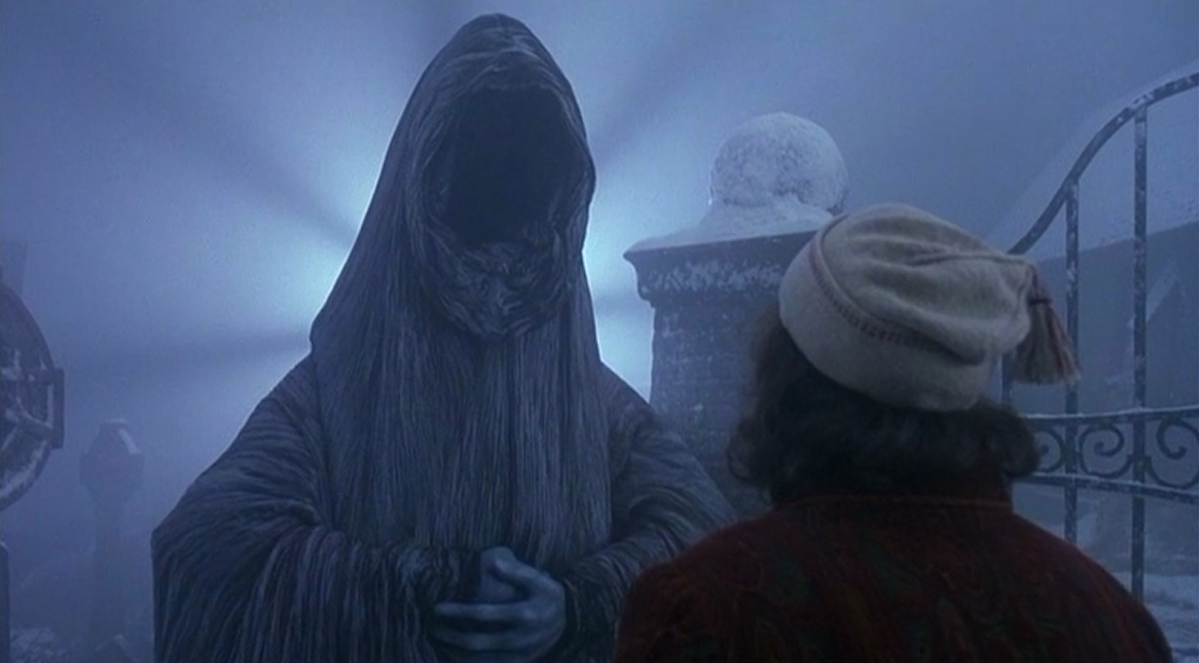
Christ, that’s just heartbreaking.

And I'm sure you know the rest. Scrooge wakes up and learns it's not too late to change.

He became as good a friend, as good a master, and as good a man, as the good old city knew, or any other good old city, town, or borough, in the good old world. Some people laughed to see the alteration in him, but he let them laugh, and little heeded them; for he was wise enough to know that nothing ever happened on this globe, for good, at which some people did not have their fill of laughter in the outset; and knowing that such as these would be blind anyway, he thought it quite as well that they should wrinkle up their eyes in grins, as have the malady in less attractive forms. His own heart laughed: and that was quite enough for him.