Wednesday, September 10, 2014

Preview: Seven No-Trump

I picked up this book in order to review it. I figured it couldn't be too bad. Zelazny wrote the introduction, and he always took care with Amber.


Holy shit, this is awful. I don't even know if the review is going to be anything more than a list of things that are wrong with this book. It's atrocious.

Why didn't someone warn me?!

Monday, September 8, 2014

Review: Doctor Who Season 8 Episode 3: Robot of Sherwood


The science of Classic Doctor Who had always been a bit...dodgy. A lot of the concepts fall apart with the most casual scrutiny, but that's okay, the guys in the rubber suits were winking at the audience, so I was fine with a MST3K hand-waving explanation.

While the reboot is darker and more tightly scripted, (more"mature") the science and the continuity really aren't all that much better. (Or at least, they haven't increased at the same pace as the audience's ability to poke holes in them.) Too often, Moffat has tried to feed us cynicism and pretend it's maturity.

Either you're silly and you know it, and you get something of a pass, or you're deadly serious, but you're held to a higher standard. Deep Breath featured a humanoid lizard from the age of the dinosaurs priggishly lecturing Clara how Marcus Aurelius was a “superlative bass guitarist", which is just as goofy as anything in this episode, but I defy you to find any joy in that scene. It's just as ridiculous as anything in Classic Who, but it's played straight.

Consequently, I enjoy the occasional episode when the program acknowledges its own absurdity. I think I liked Robot of Sherwood more than any previous episode of the revived series. It has the feel of the old show, but with modern day production values. A little bit Masque of the Mandragora, a little bit City of Death, faintly ridiculous, to be sure, but charming because of it.

We open with the Doctor writing on the blackboard, and asking Clara where she wants to go. Clara is spinning around in a chair. It looks like the blackboard is going to be a thing and not just set dressing. I like that.


Clara smiles, and requests Robin Hood, and her smile is so infectious. I like Clara.

They bicker, he relents and sets the TARDIS for 1190, but he tells her that she's only going to be disappointed, because Robin Hood didn't exist.

As they emerge from the TARDIS, the Doctor loudly declares that there is no such thing as Robin Hood, which is like an invocation to make him appear, which he does, and he places an arrow in the TARDIS.

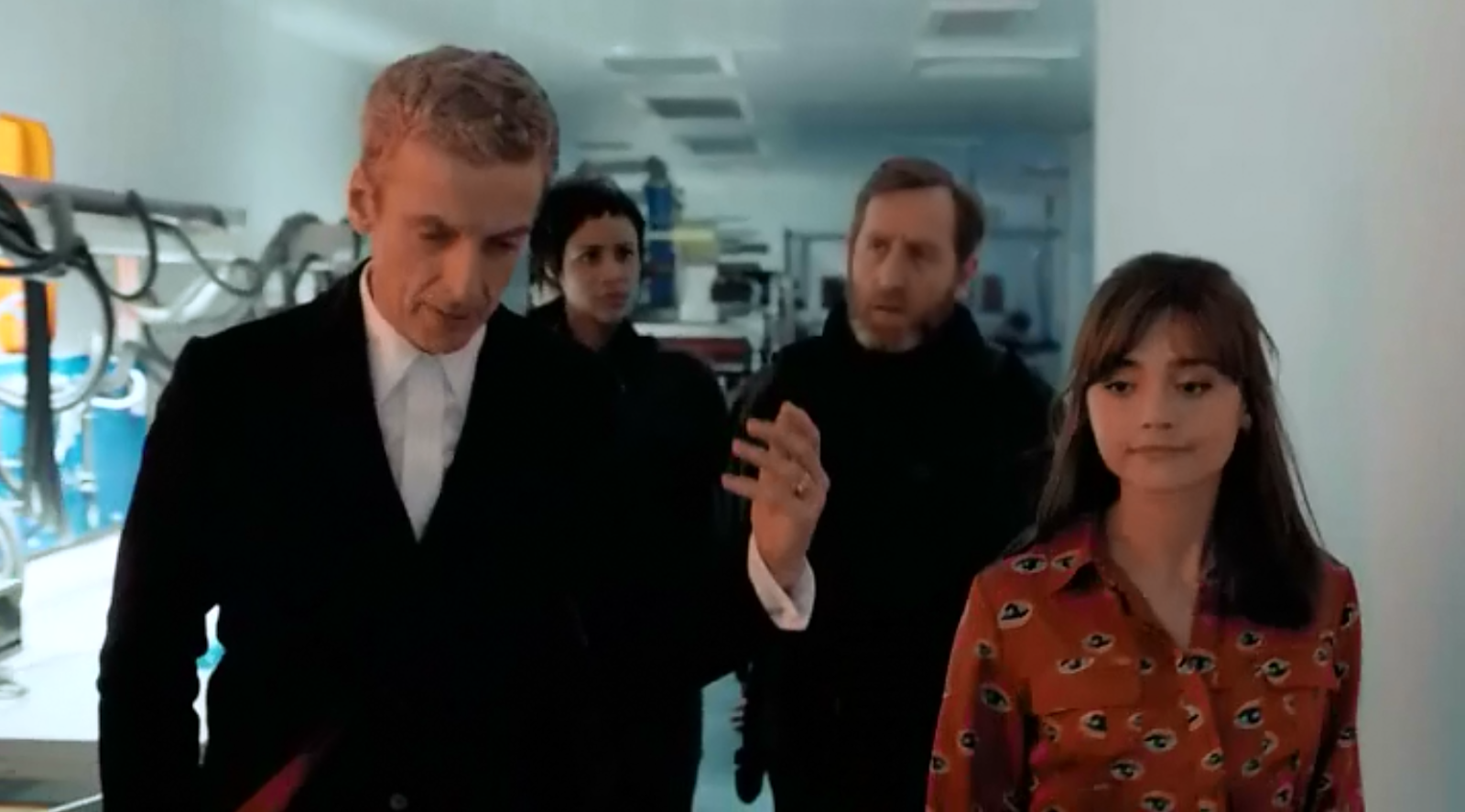
The Doctor bickers with Robin, and Clara comes out of the TARDIS in her Ren Faire costume. I like the screenshot below, because it captures their reactions. The Doctor is rolling his eyes in annoyance, and Clara is almost giddy.


I suppose this is a good time to acknowledge that this is certainly a polarizing episode. I loved it, and a lot of people hated it. Even I am not going to defend the Doctor dueling Robin Hood on a log, using a spoon.


Meanwhile, on a farm, the Sheriff of Nottingham, who looks like the love child of Anthony Ainley and Count Rugen, is strong arming peasants on a farm. He's evil in the fun way that Doctor Who villains often are.

We cut to Robin's camp, where he is introducing his Merry Men, while the Doctor tries to figure out what's going on. He rejects the idea of holograms, but suggests they might be a theme park from the future, or inside a miniscope.

The Doctor points out that only people who are sad laugh as much as Robin does, and I thought that was a really poignant observation.

A little more banter, and then we cut to the archery contest. Robin and the Sheriff are finalists, the Sheriff shoots a bullseye, but Robin splits his arrow and wins the prize, but as he is accepting it, the Doctor splits Robin's arrow with one of his own. I like the rainbow fletching.


(I didn't notice until I took that screenshot, but the Doctor is wearing a wedding ring)

The Doctor rejects the prize of the golden arrow, and requests enlightenment from the Sheriff instead, but Robin splits the Doctor's arrow while they're having this conversation. The Doctor splits Robin's arrow, and this goes back and forth until the Doctor blows up the target with his sonic screwdriver. The Sheriff earns his villain bona fides by shouting "Seize them!" to his henchmen. Someone cuts the arm off a guard, and the Doctor realizes that they're robots. He decides that the best route to enlightenment is to get captured, and that's what he does.

We then cut to the captured peasants laboring and smelting gold. The robots execute those who can't labor with their purple death rays, the targeting icon of which appears as a purple cross. I like that a lot. The robots really remind me of Classic Who villains like the Terileptils. They've got a distinctive look, they show up for a one-off and give Doctor a bit of trouble and we never see them again.

The Doctor and Robin bicker, and bicker and bicker.  I thought the archery scene was the exact right length, but this went on for just a bit too long, though it did have its moments ("I feel another laugh coming on!") I mentioned once that a lot of Tennant's early scripts seem to have been written for Eccleston, and this seems to have been written for Matt Smith. I think it's too early to say if it's at
odds
with Capaldi's characterization of the Doctor, as we've only had two episodes to establish and one of them was almost entirely post-regeneration mania, so that's a really small sample size of what the Twelfth Doctor is really like. Clara is level headed, and when she tries to ride herd on the boys, a guard identifies her as the ringleader and takes her away.

Clara is dining with the Sheriff, and she pumps him for information while playing on his vanity.Ordinarily, I'm very critical of these kinds of scenes, where the heroes know every trick, and the villains never seem to have seen a TV show or a movie, but I think it works here, because a 12th Century strongman is going to be a lot less savvy about these kind of tropes. However, he's awesome, because he managed to use "gallimaufry", so I guess the robots at least gave him an 1190 AD Word-A-Day calender.

Robin and the Doctor escape and learn that the castle is really an alien ship disguised as a castle. I even liked the design of the ship. It looked a lot like something out of Classic Who.


The Doctor learns their plans, to use the gold to repair their damaged engines in order to return to the Promised Lands, and turns on Robin, insisting that he's part of the alien's plot. He calls up the ship's databanks, showing him that the aliens have files on all sorts of myths and legends, including Robin Hood, including one particular Robin Hood who looked very familiar. I liked this concept, kind of like a Doctor Who Missionaria Protectiva

They're bickering, when the Sheriff and his robots blast down their own door, which struck me as somewhat unnecessary. Robin flees with Clara, but the Doctor is captured and imprisoned next to the young woman captured in an earlier scene.

Robin interrogates Clara, the Doctor talks the peasant lady. He's freed himself by the time a robot comes to take her away for labor, and he reflects the robot's blasts with a gold platters, and wow, shiny metal plates are already playing a large role in this season.

The other prisoners defend themselves likewise, and even though they deflect every shot back at the robots, the robots don't stop shooting at them. The Sheriff arrives, and so does Robin and his Merry Men. They tussle and Ron fights the Sheriff. I understand there is a scene within the fight that was cut, because of the recent beheadings of US hostages. Robin cuts off the Sheriff's head, but he puts it back on, explaining that he's part robot now.  The episode makes less sense without this scene, but they certainly made the right choice in removing it. The fight continues. Robin employs the move the Doctor used against him on the log to knock the Sheriff into a vat of molten gold.

"I love you." "I know."

The ship is lifting off, but the engines don't have enough power, so the ship is going to blow up, and take the countryside with it. Robin is injured and the Doctor used a homing beacon to cheat at the archery contest, so it looks like the robots are going to get away until the Doctor, Clara and Robin combine their powers to, uh, shoot the golden arrow into the ship. Along with the spoon, this is one aspect of the episode that's just plain silly. But it works, and the ship blows up harmlessly in orbit.

During the denouement, Robin asks he's only remembered as a legend in the future, and the Doctor tells him that he is. He starts telling the Doctor a story, of a man born into wealth and privilege, who found the plight of the oppressed too much to bear....who stole a TARDIS. I liked that. It was telegraphed, though not as much as the scene where the guard comes to seize the ringleader, which could be seen from space. I like the sentiment, which fits in with the theme of the rest of the season. Neither the Doctor nor Robin believe themselves real heroes, but if they fake it till they make it, they can inspire others by their example.

The TARDIS dematerializes  to reveal the Doctor's peasant lady buddy, who was really Maid Marion. On one hand, that's fine, I guess, but I didn't have a lot of investment in her. On the other, they've got dynamite chemistry.


I loved this episode. It's fun, it has no pretensions about being "serious science fiction" or changing the way we see the Doctor. It's a silly romp. It achieved what it set out to do.

Friday, September 5, 2014

I really feel that we've reached Peak Zombie

How else do you explain this zombie Lego figure costume I saw earlier today?


Edit: The costume in the wild:


Wednesday, September 3, 2014

Roger Zelazny Book Review: Dragon magazine ad for the Amber Diceless RPG

I'm trying to move towards a slightly more rigorous M/W/F publishing schedule here at Where There Had Been Darkness, so let's open with the first Zelazny post in a while. 

I suppose that I'm kind of stretching the definition by calling this a Roger Zelazny book review, but here's an interesting piece of ephemera,the ad in Dragon magazine advertising the Amber Diceless Role-playing game.


I  talked about my history with the game at the post where I covered the ADRPG itself, but to recap, I was reading a magazine in a friend's basement before a game, waiting for the other players to arrive. I saw the ad, mailed the check as soon as I got home, and had the book in hand a week later, as well as response to my fanboyish question from Erick Wujcik,"Dear Josh, thanks for your interest. You mentioned that you liked Mandor and Dalt, so I've enclosed copies of the pictures we'll be using for them in the upcoming book. Also, you asked how Bleys is pronounced. It's blaze, like a fire."

The game is stylistically, very characteristic of its era. I don't necessarily mean this in a pejorative sense, but Amber had very powerful non player characters, and it skewed very solidly to the ROLE-Playing (as opposed to ROLL-playing) side of the scale, though it's not surprising that a diceless game has a bias in that direction.

If you can't make out the text on the image, I'm reproducing it below.

AMBER is the most character intensive game ever! 
It takes hours, plus a whole gaming session, just to create a new group of Amber player characters.
Amber Characters start out with the strength to lift a car, the endurance to fight a whole day without tiring, a mind trained to psychic combat, and the battle skills of a master. Better yet, they start out as fully rounded people. 
Character building starts with players competing in an Attribute Auction, using their character's points to vie for dominance in psyche, strength, endurance and warfare.
Then players use their points to get Powers. 
Pattern is the ticket to immortality, the birthright of any Amberite, and the ultimate key to controlling worlds 
You see, our Earth is but one of an infinite number of Shadows, cast by the light of the only true world, Amber. Player characters with Pattern have the blood of Amber's ruling family. This means being able to walk among infinite alternate reality, shaping or destroying, to toy with destiny. 
The flip side of Pattern, it's opposite, is the power of the Logrus, symbol of Amber's great foe, the Courts of Chaos. Between these two powers are the lesser abilities of Magic, Shape Shifting and Trump. 
When we say no dice we mean it. No dice, coin flips, cards, yarrow sticks, computer chips or any randomness! Here's how we can do that: 
1. Characters are made with points, bidding in an Attribute Auction where the players compete for Rank. NO DICE! 
2. Combat is resolved by comparing each combatant's Rank and specific actions. The best character wins! NO DICE! 
3. Players choose their own "LUCK," spending points to be lucky, or borrowing point against bad luck. NO DICE! 
4. Ever been frustrated with a bad dice roll? In Amber, if your character can do it, consider it done! NO DICE! 
5. No Random encounters! Instead, each character is part of a story, and encounters are planned by the GM! NO DICE!"

The language in the ad worked for high school Josh ("The most character intensive game ever!") but, well, he was kind of a sucker. Today, I'd be extremely leery of something advertised with so many capital letters and exclamation points. However, I still like the art that goes along with it, because those goons attacking the swords seem like they could have sprung directly from Undershadow, or Brand's Prison Shadow.

Also, while researching this post, I discovered that a picture of me is the second result when performing an image search for Phage Press, the company that published the game. That's just weird.

Tuesday, September 2, 2014

Review: Doctor Who Season 8 Episode 2: Into the Dalek

So...it's a Dalek episode.

As a general rule, Dalek episodes might get more fanfare in the press, but are no better or worse than any other type of Doctor Who story. Some are great, some are terrible, and most fall right in the middle.

There are three Dalek stories I consider to be really good. Genesis of the Daleks, from the original series, Dalek, the first appearance of the Daleks in the new show (Jubilee, the audio play on which it was based, was even better) and Parting of the Ways, which built on what was established in Dalek. 

And then there are all the other Dalek stories, of which there are approximately eleventy billion. This isn't an instant classic, but it is surely a solid outing. It hits a lot of the same notes as Dalek, which is simultaneously its greatest strength and its greatest weakness. I went back and watched Dalek after finishing Into the Dalek, and thought "That was like Dalek, just not quite as good."

Not that I didn't like it. I thought the cold open was probably the best I've seen in the new series.


Journey Blue, a space pilot, is racing away from a Dalek saucer ship. Her co-pilot has already been killed. The ship takes a direct hit, and right before the ship blows up, she apologizes to him and the screen fades to white.

She awakens in the TARDIS, with the Doctor looking down on her. I like Capaldi's expression. The Doctor is not a human being. The cock of his head conveys something of the "alien" to his demeanor.

She pulls her gun and demands to know where her co-pilot, her brother, is.

The Doctor replies, "I materialized the time capsule exactly around you and saved your life one second before your ship exploded, but do, please, keep crying."

"My brother just died!"

"His sister didn't. Please, put the gun down."

"Or what?"

"Or then you might shoot me, and then, where would you be?"

"In charge of your vessel."

"You'd starve to death trying to find the light bulb switch."

He waves his hand at her in disapproval, and tells her "Not like that."

He's holding two cups of coffee in a cardboard carrier throughout the conversation, and if anything, this serves to accentuate his alien nature. I liked this whole scene tremendously.I was talking with my friend Corey about Clara's scene from the last episode, where she tells him that if he kills her, he'll never get what he wants. The Doctor essentially doesn't the same thing here, but he pulls it off with considerably more panache.

I really enjoyed the little details that went into it, like referring to his vehicle as a "time capsule" rather than the familiar "TARDIS". The only thing that could have made it better is if they cut in a scene from Adric from Earthshock.

"I materialized the time capsule exactly around you and saved your life one second before your ship exploded."
 "Wait, why didn't you do that for me?


Ahem. Journey puts down the gun, and stops demanding and starts requesting, and the Doctor agrees to return her to her ship once she says "please". They materialize on board, the Doctor gets all snarky about soldiers. I don't know much about Russell Davies' politics other than what I can infer from the his writing on the show, but he seems to be pretty anti-military, and consequently, so was the Doctor. This always struck me as a bit strange. Yeah, attitudes change between regenerations, but the Doctor was the scientific adviser to a paramilitary organization for a good number of years. More on this aspect a bit later.

The Doctor's contempt seems justified, because the commanding officer, 

I think his name was Beardo
orders him executed, in order to maintain the security of the base. Journey steps up and intervenes, mentioning that they have a patient, and the Doctor can probably assist. They all go to the infirmary, where the Doctor comments on a Fantastic Voyage shrink ray, and then notices the Dalek all chained up.


He declares that they won't put him in there, and credits. We return to Cole Hill school, where a teacher is leading some students in early morning exercises out in the yard. He speaks briefly with a receptionist, and then we see him in front of his class, where a student asks him if he ever killed anyone, and he admits that he was a soldier, and there were other soldiers, and some of them were on the other side.

Unlike some Misters Pink, I tip my waitress. 
This is Samuel Anderson as Danny Pink. I'm going to call him Mister Pink, so we can get some Reservoir Dogs mileage out of it. I'm pretty certain that he's here to rehabilitate the role of soldiers in Doctor Who. (And I'm using "soldier" here as a catch-all term for a member of an organized military, so for the purposes of this discussion, it's encompassing all branches of the Armed Forces.)

The reactions to Mister Pink are pretty weird. It seems like he's the first soldier anyone has ever encountered. There are a lot of soldiers and former soldiers out there. I've had family members, bosses, colleagues and friends who are or were soldiers, and I think that's probably pretty representative. Other than generally being more disciplined than the population at large, I don't think service members have any traits that differentiate themselves from their civilian cohorts, simply because they're drawn from that pool. I don't think every service member is a hero (though some of them are), and nor do I think every one is an asshole (though some of them are, too). Stereotypes exist, but they tend to die quickly once you're exposed to a real live member of that group. It seems strange that the Cole Hill group has apparently never met a soldier. I think we're going to learn along with them that soldiers are people, just like you and me.

Clara chats with him, but she's a bit of an ass, ([In reference to the morning calisthenics:] Mr. Pink: Oh, the Cole Hill Cadets? That's just a bit of fun. Clara: "What, teaching them how to shoot people?" Mr. Pink: "There's a bit more to modern soldiering than just shooting people. I like to think there's a moral dimension. Clara: "Ah, so you shoot people and cry about it afterwards?")   Holy shit, that's an asshole thing to say to anybody. The scene awkwardly transitions into flirting, and it's awful.

The Doctor shows up with her coffee, and they take off. Apparently, the soldiers on the space station who were obsessed about security, and were willing to shoot a stranger who just did them a good turn were willing to let him go as long he promised really, really hard that he'd be right back after he delivered his coffee.

It's worth noting that Clara is wearing a shirt covered with eyeballs, and it's just very disturbing.


The Doctor was unwilling to help the Dalek, until he realizes that the Dalek wants to kill other Daleks. A couple of the soldiers shrink down with him, including Journey, whose brother just burned to death a couple hours ago, which struck me as a rather questionable decision.

"Yup, here's your problem, someone set this thing to evil."
The scenes inside the Dalek have some nice visuals, but they struck me as so obviously a gimmick that it took me out of the story. I did like the part where a soldier has been targeted by antibodies, and the Doctor gives him something to swallow that leads him to believe that will save him, but really just allows the Doctor to track where his remains are dumped. Some more stuff happens, and the Doctor realizes that the Dalek is suffering from a malfunction, which he corrects, which turns the Dalek's morality switch back to evil.

The Dalek summons other Daleks, and they start exterminating the population of the space station. One of the soldiers sacrifices herself, and winds up with Missy from the earlier episode. The Doctor flips the Dalek's switch back to good.


It exterminates a bunch of Daleks, and we get what I can only assume is a callback to Dalek where it, tells the Doctor that the Doctor is a good Dalek. That's kind of odd decision. Journey asks to come along, but the Doctor refuses, because she's a soldier. This is contrasted at the end where Clara accepts Mister Pink's past as a soldier.

They make a good looking couple

I liked the episode, but, well, I said it earlier in the post. It's too much like Dalek, which is eight years old at this point, but hardly forgotten. The scenes inside the Dalek went on a bit too long, but the bits with Capaldi were again outstanding. Coleman and Anderson have a nice chemistry too, and I look forward to seeing more of Mister Pink.