I've lost faith in a lot of the things I believed in as a child.
I stopped believing in God and Santa Claus decades ago and on bad days I don't even believe in myself.
But I still believe in a Wrinkle in Time.
It is my desert island book. It's the book that reminds me that there is still goodness in the world.
The 2003 movie was pretty bad, but I approached this version with tempered enthusiasm. Jennifer Lee had been the screenwriter for
Frozen, so that was encouraging.
But I really don't understand how she managed to miss the meaning of the book so completely. It's one of the few properties about which I'm still sentimental and they messed it up so badly that I was just short of actually angry.
I guess I'll open with what I liked about the movie.
THE GOOD
 Meg Murray:
 Meg is probably white in the book, but that whiteness isn't essential to her character, so I don't have any problems with the change. Storm Reid (who has a great name) does an outstanding job with the performance. I'd go so far as to say that she's the best part of the film. The idealized Meg with straightened hair was a good scene, and I don’t think it would have had the same punch with a white girl in the role.
The scenes with baby Meg and her dad were really cute too.
Red: He was a departure from the character in the book, but I thought Red worked pretty well. The bit with the sandwich being literal sand (instead of just tasting like sand) was a bit on-the-nose for my liking, but affably evil characters can be frightening in a way more obviously evil villains aren’t and he’s a good contrast to the capital E Evil of the IT. The puppet metaphor went on a bit too long, but it wasn’t bad conceptually.
The IT: This is another change that more or less worked. Calling the adversary “IT” works in a novel, where you can see the capitalization, but it would lead to confusion in a movie already populated by Whos, Whiches and Whatsits galore. Adding the article in front of IT is a small change, but I would argue that it’s almost a necessary one for clarity’s sake. Also, the weirdo psychedelic brainscape was a little ostentatious (like the rest of the movie), but a.) at least there was no glitter and b.) IT as described in the book (a slightly oversized brain on a dais) probably would have looked silly on screen.
Enfolded: I liked the recurring motif of things being present but hidden from sight because they’re enfolded. The visual of the paper fortune teller works and the set-up more or less pays off. I thought they were going to use it to illustrate a tesseract, but they didn’t, and that seems like a missed opportunity.
Some good scenes: The montage of misery on the earth was a truly well-composed sequence. Ava DuVernay does a great job with the quiet, human moments, and those moments should have served as the core of the movie, but they were lost in favor of spectacle.
The Bad
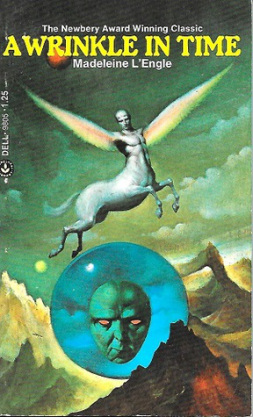
Mrs. Whatsit: "Now, don't be frightened, loves," Mrs. Whatsit said. Her plump little body began to shimmer, to quiver, to shift. The wild colors of her clothes became muted, whitened. The pudding-bag shape stretched, lengthened, merged. And suddenly before the children was a creature more beautiful than any Meg had even imagined, and the beauty lay in far more than the outward description. Outwardly Mrs. Whatsit was surely no longer a Mrs. Whatsit. She was a marble-white body with powerful flanks, something like a horse but at the same time completely unlike a horse, for from the magnificently modeled back sprang a nobly formed torso, arms, and a head resembling a man's, but a man with a perfection of dignity and virtue, an exaltation of joy such as Meg had never before seen. No, she thought, it's not like a Greek centaur. Not in the least.
From the shoulders slowly a pair of wings unfolded, wings made of rainbows, of light upon water, of poetry.
Hold that image in your mind. The book cover at the top of the post can serve as a useful reference. Go back and read it again if you need to. I didn't see anything describing a flying piece of asparagus with Reese Witherspoon's chin, but that's what we got.
It's nice to see Archibald is still finding work after Veggie Tales.
 |
| I want everyone to know that Lily is the one who came up with asparagus joke. |
Mrs. Who: Her distinguishing trait in the novel is that she speaks in quotations. They dispense with that about a third of the way through the movie, at about the point where she wore a bustle while running through flowers who were also running.
She loses additional points for quoting Chris Tucker. What’s the matter, couldn’t they get the rights to wubba lubba dub dub? Mrs. Who quotes Chris Tucker and the attribution, “Tucker, American” is longer than the quote. Ugh. Listen. I understand the desire to be topical, and those kids today (shakes rake at them to warn them off my lawn) aren’t going to understand the provenance of a quote by Blaise Pascal. But this is barely even a catchphrase.
Mrs. Which: I was nervous about Oprah Winfrey in the role because I thought her presence would prove distracting because she's one of the most famous human beings in the world.
I was wrong. She was even
more distracting than I had feared because she was one hundred feet tall and covered with glitter.
 |
| The Titans have breached Wall Maria. |
In the movie, she says, "Trust nothing." Do you have that Fox Mulder "I want to believe" poster hanging on your wall, Mrs. Which?
Give me that old-time religion: I'm not religious myself, but Madeleine L'Engle's particular brand of Christian Universalism serves as the core of the book.("All will be redeemed in God's fullness of time, all, not just the small portion of the population who have been given the grace to know and accept Christ. All the strayed and stolen sheep. All the little lost ones.")
I don't think it can be removed without changing the story fundamentally and you certainly can't just rip it and continue on with nothing in its place, as was done here. The movie is empty inside.
The Writing: It's often just bad. "She's evolved beyond the need for language." "Charles Wallace doesn't live here anymore." Seriously? Even children's cartoons know they can't get away with playing that line straight anymore. Calvin disappears almost completely for the final twenty minutes of the movie. We were joking that he'd be calling for the other characters on Camazotz during a post-credit sequence.
Crappy Mentors: A Wrinkle in Time served as an influence on my Doctor Who story,
Forever Fallen. I also loved the Doctor's relationship with Ace because he could solve her problems for her easily enough, but instead, he helps her become the version of herself capable of solving those problems. That same dynamic is at play in the book, but the movie features mentors that neither like nor respect their charges and it just doesn't work. What's the point?
The Happy Medium: Zach Galifianakis plays the medium as a gymnast/soothsayer. Kudos for playing against type, but not an interpretation that grounds the movie, is it?
 |
| Walk like an Egyptian |
Charles Wallace goes down like a chump: In the book, Charles Wallace goes into IT’s grasp willingly, because IT has promised him that the location of his father is in there and he believes he’s strong enough to pull himself out once he’s in there. Pride is his fatal flaw and it’s this overconfidence that gets him. In the movie, The Man with Red Eyes takes control of Charles Wallace by reading from his second-grade math homework.
I’ve touched on this before, but love is the theme of the book. Meg is poisoned by doubt, but she knows as certainly as she knows anything that Charles Wallace loves her. Her mother loves her. Her father loves her. They love each other and despite her doubts about other things, Meg knows this. The Mrs. Whatsit of the books loves her.
"Mrs. Whatsit hates you," Charles Wallace said.
And that was where IT made ITs fatal mistake, for as Meg said, automatically, "Mrs. Whatsit loves me; that's what she told me, that she loves me," suddenly she knew.
She knew!
Love.
That was what she had that IT did not have.
She had Mrs. Whatsit's love, and her father's, and her mother's, and the real Charles Wallace's love, and the twins', and Aunt Beast's.
And she had her love for them.
But how could she use it? What was she meant to do?
If she could give love to IT perhaps it would shrivel up and die, for she was sure that IT could not withstand love. But she, in all her weakness and foolishness and baseness and nothingness, was incapable of loving IT. Perhaps it was not too much to ask of her, but she could not do it.
But she could love Charles Wallace. She could stand there and she could love Charles Wallace. Her own Charles Wallace, the real Charles Wallace, the child for whom she had come back to Camazotz, to IT, the baby who was so much more than she was, and who was yet so utterly vulnerable.
Charles. Charles, I love you. My baby brother who always takes care of me. Come back to me, Charles Wallace, come away from IT, come back, come home. I love you, Charles. Oh, Charles Wallace, I love you.
Movie Mrs. Whatsit’s opinions on Meg range from disgust to disinterest. Why is she even there if she feels this way?
What I’d like to see is a more or less straight adaptation of the book as an animated film by studio Ghibli. Hayou Miyazaki can helm it the next time he comes out of retirement.
Grrr...So bitterly disappointed in what we got.